IYC News And Updates
IYC's Ms. Abinaya Kandasamy Delivers Keynote at MRICS 2026 on AI, Arts, and Inclusion
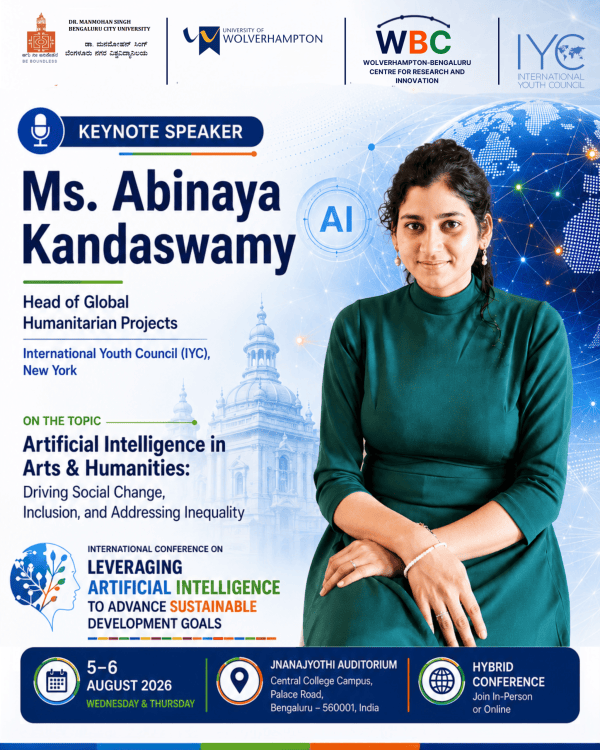
IYC’s Ms. Abinaya Kandasamy Delivers Keynote at MRICS 2026 on AI, Arts, and Inclusion
Bengaluru, India — 6 August 2026
Ms. Abinaya Kandasamy, Head of Global Humanitarian Projects at the International Youth Council (IYC) Headquarters in New York, took the stage today as a keynote speaker at MRICS 2026 — the International Conference on Leveraging Artificial Intelligence to Advance Sustainable Development Goals, hosted by the Wolverhampton–Bengaluru Centre for Research and Innovation at Jnanajyothi Auditorium, Bengaluru.
Her keynote, “Artificial Intelligence in Arts & Humanities: Driving Social Change, Inclusion, and Addressing Inequality,” examined a question rarely asked in AI discourse: what happens when artificial intelligence meets the disciplines that study the human condition — literature, history, art, and culture.
Key Messages from the Address
AI as collaborator, not creator. Ms. Kandasamy argued that AI does not originate art but expands the range of creative possibilities available to artists — functioning less like a replacement and more like a capable assistant. She noted that AI can imitate style and produce technically accomplished work, but cannot draw on lived experience, meaning human judgement remains essential to giving that work meaning.
Technology has never displaced the storyteller. Drawing a parallel to earlier innovations — the printing press, the camera, and the internet — she observed that each was once feared as a threat to human creative professions, yet none displaced them. She suggested AI will follow the same pattern, amplifying human-made art rather than replacing it.
AI as a force multiplier for the SDGs. With only four years remaining to the UN’s 2030 deadline and persistent shortages of teachers, doctors, and climate scientists in underserved regions, Ms. Kandasamy positioned AI as a tool to extend the reach of human expertise — not substitute for it.
Closing the inequality gap. She highlighted several concrete applications where AI is already narrowing access gaps:
Translating legal documents, government forms, and literature into underrepresented languages, expanding access for communities long excluded by a content landscape dominated by a handful of major languages
Converting text to speech and speech to text to support people with visual and hearing impairments
Digitising endangered art forms and oral traditions so they can be preserved across generations
A call to the arts and humanities to lead. Ms. Kandasamy urged the sector to take an active role in shaping how AI is used — asking whose stories are being told, who remains unheard, and whether outcomes are fair — arguing that these are questions only human judgement, not algorithms, can answer.
She closed by distinguishing what AI can do from what only people can do: it can process information at scale, but only humans can perceive dignity, feel meaning, and judge fairness.
The session drew strong engagement from delegates, researchers, and policymakers attending MRICS 2026, reinforcing IYC’s continued commitment to ensuring emerging technologies serve inclusion, equity, and human dignity.
#MRICS2026 #KeynoteSpeaker #ArtificialIntelligence #ArtsAndHumanities #Innovation #Research #SDGs #InternationalYouthCouncil #TeamIYC